Precision Heritage and Smart Timber Engineering: Industry 4.0 Automation, Raw Material Economics, and Export Strategy for Distressed Solid Wood TV Units in Turkey
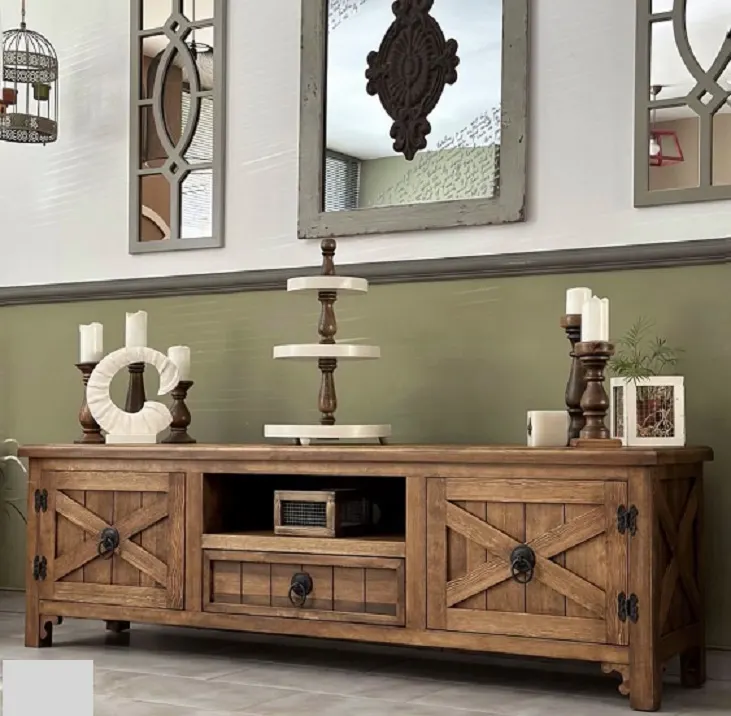
The modern media console sits at a fascinating intersection of aesthetic nostalgia and high-tech functionality. Today’s discerning homeowner wants a living room centerpiece that looks like a century-old Anatolian farmhouse relic—complete with hand-hewn bevels, wire-brushed oak grain, weathered iron hardware, and deep mineral patinas—yet secretly houses 8K OLED displays, Dolby Atmos soundbars, gaming consoles, concealed Qi wireless charging pads, and thermostatically controlled cooling airflow.
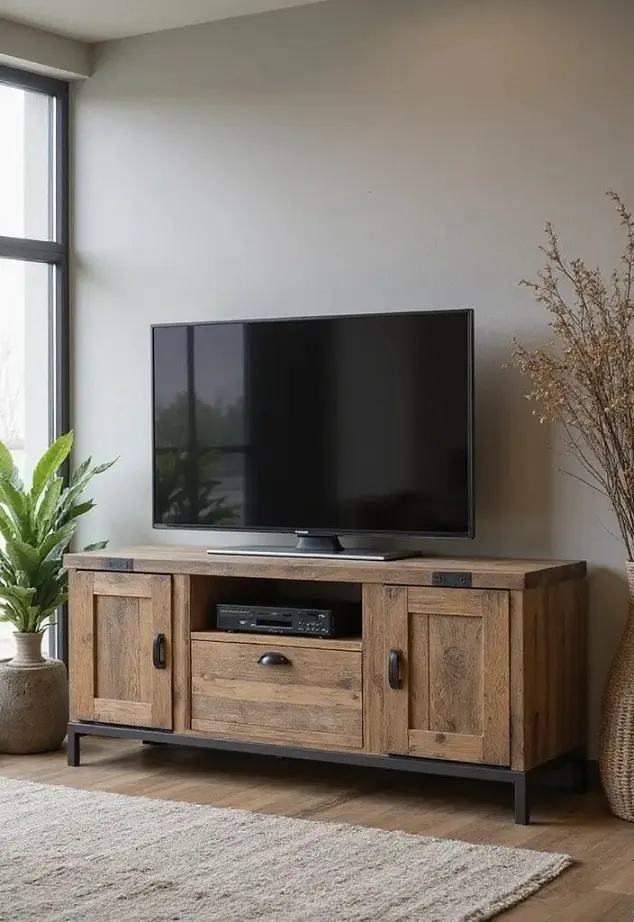
Delivering this dual mandate at competitive global price points is the defining achievement of Precision Heritage and Smart Timber Engineering: Industry 4.0 Automation, Raw Material Economics, and Export Strategy for Distressed Solid Wood TV Units in Turkey.
Across Turkey’s premier woodworking clusters—spanning İnegöl, İstanbul, Kayseri, Ankara, and İzmir—manufacturers have reimagined solid wood casegoods production. By integrating 5-axis German and Italian CNC machining centers with multi-generational hand-finishing ateliers, optimizing raw lumber imports through Turkish ports, and utilizing bilateral tariff exemptions into Europe and North America, Turkish producers have built an unrivaled competitive moat. Whether you are a furniture manufacturer upgrading factory automation, a timber importer analyzing Turkish sawmill economics, or an international product engineer sourcing smart rustic-modern consoles, Precision Heritage and Smart Timber Engineering: Industry 4.0 Automation, Raw Material Economics, and Export Strategy for Distressed Solid Wood TV Units in Turkey offers an authoritative deep dive into the machinery, material flows, and market mechanics shaping the industry.
1. Raw Material Import Economics and Turkish Forestry Supply Chains
A rigorous analysis of Precision Heritage and Smart Timber Engineering: Industry 4.0 Automation, Raw Material Economics, and Export Strategy for Distressed Solid Wood TV Units in Turkey must begin at the sawmill and container port. Producing solid wood TV units at industrial export scale requires uninterrupted access to kiln-dried hardwoods and softwoods with predictable grading, dimensional consistency, and legal provenance.
Domestic Timber Procurement via OGM Auctions
Turkey possesses roughly 23 million hectares of forestland managed under strict state stewardship by the General Directorate of Forestry (Orman Genel Müdürlüğü - OGM). Unlike North American private timberland markets, Turkish domestic roundwood and sawn timber are sold primarily through scheduled regional electronic auctions (e-Satış) held by OGM regional directorates in Kastamonu, Bolu, Zonguldak, Bursa, and Artvin:
• Anatolian Chestnut (Castanea sativa) & Turkish Oak (Quercus petraea): Harvested selectively from Black Sea and Marmara stands, these logs are prized by İnegöl and Ankara factories for their high density, coarse ring-porous structure, and rich natural tannin profiles.
• Steamed Beech (Fagus orientalis) & Scots Pine (Pinus sylvestris): Abundant across northern Anatolia, beech and pine serve as structural workhorses for mid-market distressed media units and interior drawer joinery.
• Supply Constraints: Because OGM enforces strict annual allowable cut quotas to expand national forest cover and protect watersheds, domestic hardwood supply alone cannot satisfy Turkey’s booming furniture export sector—making imported lumber essential.
Global Lumber Import Corridors into Turkey
To bridge the raw material gap and satisfy international retail specifications, Turkish timber importers and large vertically integrated furniture factories import hundreds of thousands of cubic meters of rough-sawn lumber (HS Code 4407) annually:
1. North American Hardwood Corridor: Rough-sawn, kiln-dried American White Oak, Red Oak, Ash, and Black Walnut are shipped in 40' containers from Appalachian sawmills (via Norfolk, Savannah, and Charleston) directly into Mersin, Gemlik, and Ambarlı ports. American White Oak is heavily favored by US and UK retail chains for cerused and wire-brushed TV units due to its uniform pale color and prominent medullary rays.
2. Eastern European & Balkan Hardwood Corridor: European Oak and Beech enter Turkey via overland trucking and Black Sea vessels from Romania, Croatia, Bulgaria, and Ukraine. European oak features tighter growth rings and higher natural knot frequency, making it ideal for rustic, reclaimed-aesthetic consoles.
3. Northern Eurasian Softwood Corridor: Siberian Larch and Scandinavian Spruce/Pine arrive at Black Sea ports (Samsun, Trabzon, Karadeniz Ereğli) for farmhouse and coastal distressed media consoles.
Customs Optimization: The Inward Processing Regime (DİR)
Importing rough-sawn lumber into Turkey normally incurs customs duties (ranging from 0% to 5% depending on origin and FTA status) plus 20% Value Added Tax (KDV). However, export-oriented manufacturers bypass these upfront tax burdens entirely using Turkey’s Inward Processing Regime (Dahilde İşleme Rejimi - DİR):
• Under an approved DİİB (Inward Processing Authorization Certificate), factories import American White Oak lumber, European birch plywood, and Austrian/German soft-close hardware 100% exempt from import tariffs and KDV.
• Customs authorities track raw timber volume against finished TV unit export declarations using standardized industrial waste yield coefficients (typically allowing 32% to 42% kerf, planing, and defect-trimming allowance for rustic solid wood milling).
• This financial mechanism lowers working capital lockup by roughly 22%, enabling Turkish factories to quote sharper FOB prices than regional competitors.
2. Industry 4.0 CNC Automation Meets Artisanal Hand-Distressing
Historically, distressed solid wood furniture suffered from a major scaling bottleneck: purely handcrafted pieces were too expensive and inconsistent for major retail chains, while purely machine-stamped "distressed" pieces looked repetitive and synthetic. In Precision Heritage and Smart Timber Engineering: Industry 4.0 Automation, Raw Material Economics, and Export Strategy for Distressed Solid Wood TV Units in Turkey, leading Turkish factories solve this paradox through hybrid cellular manufacturing.
Automated Rough-Mill Optimization & Defect Scanning
Modern Turkish factories in İnegöl and Kayseri utilize optical scanner-equipped crosscut and rip lines (such as Weinig OptiCut systems):
• Laser & Camera Grain Mapping: High-speed optical sensors scan every incoming oak or chestnut board for moisture pockets, structural splits, loose dead knots, and sapwood ratios.
• Selective Knot Retention: Unlike clear-wood furniture lines that chop out every knot, distressed TV unit software algorithms are programmed to retain tight, intergrown sound knots and mineral streaks—maximizing timber yield by up to 18% while enhancing rustic character.
• Automated Finger-Jointing & RF (Radio Frequency) Pressing: Narrow staves (55–80 mm wide) are edge-glued using EN 204 D4 waterproof polyurethane adhesives and cured in high-frequency RF hydraulic presses in under 90 seconds, producing dead-flat solid wood panels with minimal clamping downtime.
5-Axis CNC Precision Milling & Joinery
Once laminated panels are calibrated through wide-belt abrasive planers, 5-axis CNC machining centers (Homag, SCM, Biesse) execute complex structural joinery with ±0.05 mm repeatability:
• Hidden Steel Reinforcement Channels: CNC routers mill recessed T-slots or C-channels into the underside of long 200–260 cm solid wood tops to house galvanized steel anti-sag bars.
• Dovetail & Mortise-and-Tenon Joinery: Drawer boxes are milled with interlocking English dovetails, while cabinet frames receive blind mortise-and-tenon joints that withstand decades of heavy AV equipment loads.
• Variable-Depth Programmable Distressing: Using custom-ground radius cutters and oscillating aggregate heads, 5-axis CNC spindles can mill randomized edge-wear scallops, undulating hand-planed surface waves, and organic chamfer variations across panel edges—ensuring no two TV units exhibit identical machine patterns.
The Human Finishing Touch: Controlled Artisanal Chaos
Following CNC milling, panels move to dedicated hand-distressing benches where skilled Turkish craftsmen (ustalar) apply non-repetitive organic wear:
• Multi-Axis Wire Brushing: Rotary Tynex abrasive nylon brushes excavate soft earlywood vessels along the grain, creating tactile 3D relief.
• Percussive & Tool Marking: Artisans selectively apply hand-forged iron rasps, drawknives, link chains, and awl clusters (simulating antique woodworm tunnels) around natural knots and high-touch corners.
• Multi-Layer Chemical & Glaze Finishing: Automated Cefla reciprocating spray robots apply uniform base stains and 2K polyurethane sealers, while human finishers hand-wipe pigmented glazes and cerusing pastes across the textured grain—achieving the irreplaceable depth of hand-rubbed antiques at industrial throughput speeds.
3. Smart-Home Electronics, Acoustic Transparency, and Thermal Engineering
A modern distressed solid wood TV unit must seamlessly integrate 21st-century home theater technology without compromising its rugged, timeless exterior. Within Precision Heritage and Smart Timber Engineering: Industry 4.0 Automation, Raw Material Economics, and Export Strategy for Distressed Solid Wood TV Units in Turkey, product engineers incorporate four specialized electronic and acoustic design features:
1. Acoustically Transparent & IR-Pass-Through Door Engineering
Homeowners increasingly dislike visible black speaker grilles and blinking cable-box LEDs cluttering rustic living rooms. Turkish R&D teams solve this via specialized door construction:
• Micro-Slatted Solid Wood Louvers: CNC routers mill precision solid oak slats spaced at exact acoustic ratios (typically 8 mm slat width with 6 mm air gaps) backed by acoustically transparent black speaker cloth. Soundbars and center-channel speakers placed inside the closed cabinet project crisp dialogue with less than 1.2 dB attenuation, while infrared (IR) remote control signals pass through effortlessly.
• Woven Natural Rattan & Perforated Antique Brass Mesh: Popular in Mediterranean and transitional designs, hand-woven cane or antique-patinated brass grilles allow full airflow and RF/IR signal transmission while concealing subwoofers and gaming consoles.
2. Concealed Qi Wireless Charging & Integrated Power Hubs
Using 5-axis CNC routers, Turkish manufacturers mill blind pockets into the underside of 35–40 mm thick solid wood tops, leaving a thin 3 mm to 4 mm solid wood membrane intact on the upper surface. High-output 15W Qi wireless charging coils are mounted flush inside these hidden cavities, marked subtly on the distressed tabletop by a laser-burned or brass-inlaid icon—allowing users to charge smartphones simply by setting them on the rustic wood surface. Additionally, rear interior compartments integrate recessed UL/CE-certified power strips with dual USB-C PD ports.
3. Passive & Active Thermal Management
High-performance gaming consoles (PlayStation 5, Xbox Series X) and multi-channel AV receivers generate substantial waste heat inside enclosed wooden cabinets:
• Chimney-Effect Passive Ventilation: Engineers route hidden intake slots along the bottom plinth and exhaust vents along the upper rear rail, creating natural convective airflow without visible holes on the front facade.
• Whisper-Quiet Thermostatic Exhaust Fans: For luxury custom media consoles, Turkish factories pre-install ultra-quiet (< 18 dBA) brushless DC cooling fans triggered automatically by an internal thermal probe whenever cabinet air temperature exceeds 32°C.
4. Hidden Cable Management Raceways
Thick solid wood back panels feature CNC-milled vertical and horizontal cable channels, magnetic removable access hatches, and solid brass grommets—allowing thick HDMI 2.1 and power cables to route invisibly between compartments and exit cleanly toward wall outlets.
4. Export Trade Compliance, Tariffs, and Global Market Access
Scaling Precision Heritage and Smart Timber Engineering: Industry 4.0 Automation, Raw Material Economics, and Export Strategy for Distressed Solid Wood TV Units in Turkey across international borders requires rigorous adherence to customs classifications, preferential trade agreements, and environmental regulations.
Tariff Engineering and Duty-Free Market Access
• HS Code Classification: Solid wood TV units, media consoles, and entertainment credenzas are classified globally under HS Code 9403.60 (Other wooden furniture, of a kind used in dining rooms and living rooms).
• European Union (0% Duty via A.TR): Under the EU-Turkey Customs Union, all solid wood TV units manufactured in Turkey—even when built from imported American White Oak or Siberian Larch—qualify for 0% import customs duty into all 27 EU member states when accompanied by a validated A.TR Movement Certificate.
• United Kingdom & EFTA (0% Duty via EUR.1): Preferential origin rules under the UK-Turkey FTA and EFTA-Turkey FTA grant 0% tariff entry into Great Britain, Switzerland, and Norway.
• United States (0% MFN Rate & Section 301 Advantage): Unlike Chinese wooden furniture hit with punitive 25% Section 301 tariffs, Turkish solid wood living room furniture (HTSUS 9403.60.8081) enters the United States at the standard Most Favored Nation (MFN) rate of 0% (Free).
Environmental & Timber Legality Frameworks
1. EU Deforestation Regulation (EUDR): Turkish exporters maintain digital traceability systems linking raw timber batch numbers to exact GPS polygon geolocation coordinates of the forest harvest plots, proving zero deforestation after December 31, 2020.
2. FSC® & PEFC Chain-of-Custody: Leading İnegöl and İstanbul manufacturers hold active FSC CoC certifications, enabling retail partners to display official FSC eco-labels on hangtags and e-commerce product listings.
3. US Lacey Act & TSCA Title VI: Every US-bound shipment includes a complete Lacey Act declaration (PPQ Form 505) detailing botanical species (Quercus alba, Castanea sativa, etc.) and harvest country, alongside TSCA Title VI / CARB Phase 2 formaldehyde compliance certificates for any birch plywood sub-components.
5. Strategic Export Channels and B2B Lead Generation in Turkey
For international furniture buyers seeking vetted Turkish suppliers—or Turkish manufacturers scaling global export operations—several institutional platforms and trade events anchor the ecosystem:
• İİFF (Istanbul Furniture Fair): Held every January across Tüyap and İstanbul Expo Center, İİFF is one of Europe’s premier furniture trade exhibitions, attracting buyers from over 140 countries to inspect solid wood collections firsthand.
• MODEF Expo (İnegöl): Held biannually in spring and autumn, MODEF allows international procurement directors to tour factory floors, drying kilns, and spray lines directly in İnegöl alongside showroom meetings.
• High Point Market (North Carolina, USA) & Salone del Mobile (Milan, Italy): Supported by export incentives from the Turkish Ministry of Trade and MOSFED (Federation of Furniture Associations), top-tier Turkish solid wood manufacturers increasingly exhibit directly at High Point and Milan to build direct relationships with North American and Western European retail buyers.
• Türk Eximbank & Export Financing: Turkish exporters utilize low-interest Türk Eximbank pre-shipment export credits and international buyer credit insurance to offer competitive 60-to-90-day open account or L/C terms to creditworthy European and American retail chains.
Frequently Asked Questions (FAQ)
How do Turkish manufacturers integrate wireless charging into solid wood TV units?
Using 5-axis CNC routers, Turkish factories mill a precision pocket into the underside of the solid wood top panel, leaving a 3–4 mm wooden layer intact on top. A 15W Qi wireless charging transmitter is mounted inside this hidden cavity, allowing devices placed on the distressed wood surface to charge invisibly without altering the rustic aesthetic.
What prevents enclosed solid wood media cabinets from overheating AV receivers and gaming consoles?
Export-grade Turkish TV units incorporate CNC-routed passive intake slots in the bottom plinth and exhaust vents along the upper rear panel to promote convective airflow, alongside optional ultra-quiet (< 18 dBA) thermostatically controlled DC exhaust fans for high-heat home theater setups.
How does Turkey secure enough hardwood to supply global solid wood furniture exports?
Turkish manufacturers combine domestic hardwoods purchased through state-regulated General Directorate of Forestry (OGM) electronic auctions—such as Anatolian Chestnut and Turkish Oak—with duty-free imported American White Oak and European Oak brought in under Turkey’s Inward Processing Regime (DİR).
What are the key trade fairs for sourcing distressed solid wood TV units in Turkey?
The two premier industry exhibitions in Turkey are the Istanbul Furniture Fair (İİFF) held every January in İstanbul, and MODEF Expo held twice a year (spring and autumn) directly in the manufacturing hub of İnegöl, Bursa.